
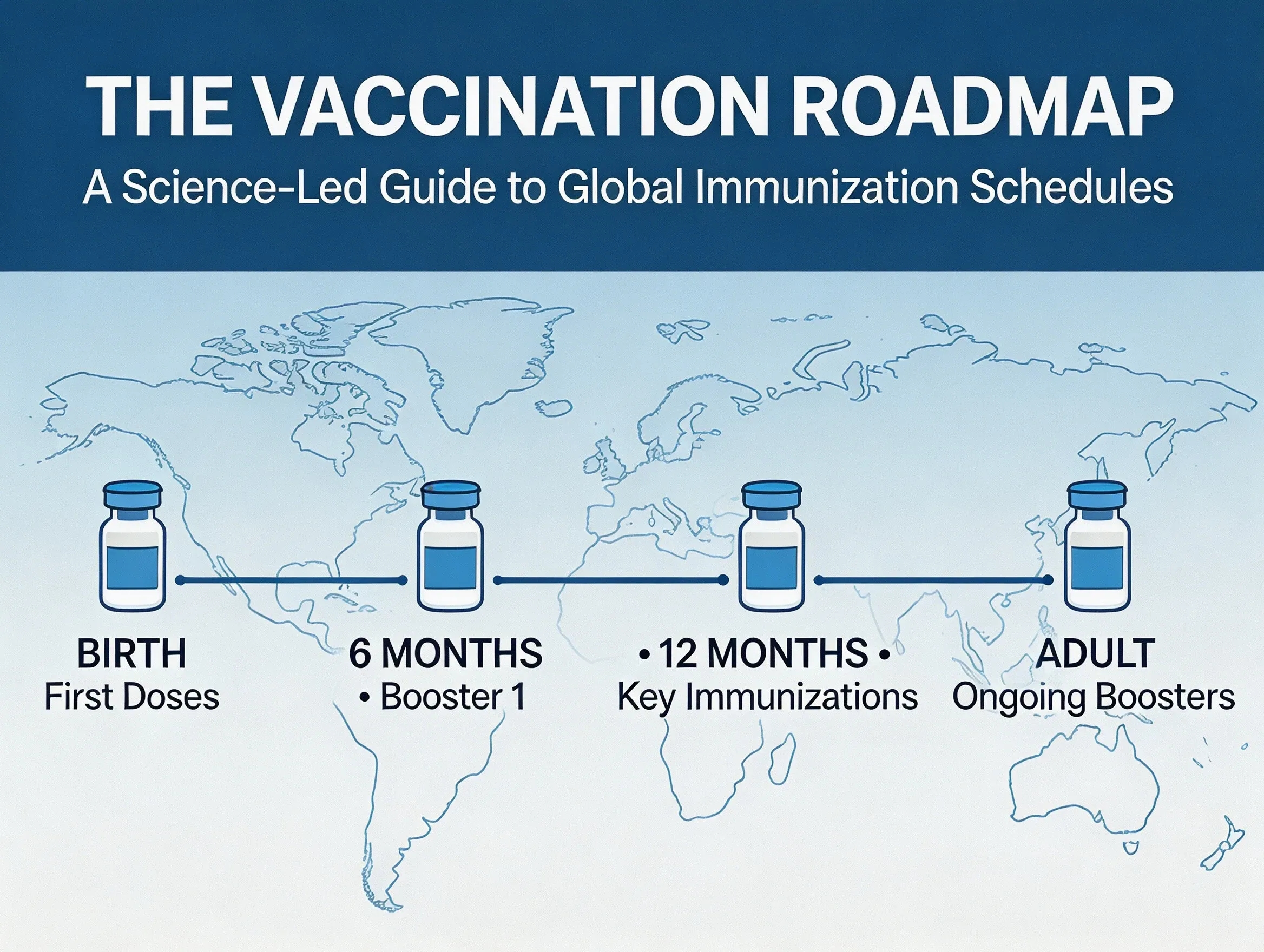
The Vaccination Roadmap: A Science-Led Guide to Global Immunization Schedules
- Published on
- //5 mins read/––– views
If you have looked up vaccine schedules in two countries and found different timing, you are not alone. Many parents worry that differences mean one system is "wrong." In reality, national immunization schedules are evidence-based frameworks shaped by disease risk, vaccine availability, program logistics, and local epidemiology.
This guide helps you read global schedules with confidence—without guessing, panic, or misinformation.
Why immunization schedules differ across countries
Vaccination schedules are built using common scientific principles, but implementation differs by setting.
Key reasons include:
- Disease burden and transmission patterns (some infections circulate differently by region)
- Health-system design (visit timing, primary care access, and reminder systems)
- National advisory processes (country committees align global recommendations to local realities)
- Program updates over time (new evidence, new products, and policy revisions)
So a different month marker does not automatically mean lower quality care. It often reflects local optimization.
The common core most schedules share
Across major guidance systems (WHO, CDC, NHS/UK programs, EU tools, Canada, Australia), the broad goals are consistent:
- Protect infants and young children before high-risk exposure windows.
- Build durable immunity through primary series plus boosters where needed.
- Catch up missed doses safely rather than restarting entire series in many cases.
- Prioritize equity by reducing "zero-dose" children and access gaps.
The details vary, but the protection logic is shared.
How to compare schedules safely: WHO vs country schedules
A practical way to compare any two schedules:
Step 1: Start with WHO routine immunization summary tables
WHO position-paper tables provide global reference points by vaccine and age band.
Step 2: Check your country’s current official schedule
Use your national source (e.g., CDC for U.S., NHS/GOV.UK for UK, ECDC scheduler for EU/EEA views, Public Health Agency guidance for Canada, NIP schedule for Australia).
Step 3: Confirm updates and implementation dates
Schedules can change. Always verify the most recent publication date and update notices.
Step 4: Ask about catch-up rules, not just "on-time" rules
If you are late, moved countries, or changed providers, catch-up pathways are the most important part.
Practical parent scenarios (travel, relocation, delayed doses)
Scenario A: Moving countries with a partially completed schedule
Bring a complete written vaccine record (dates, product names if available, lot/clinic info when possible). Clinicians can map prior doses to local schedule and build a catch-up plan.
Scenario B: Missed appointment during infancy
In most cases, missed doses are caught up rather than starting over. The exact interval depends on vaccine product and age.
Scenario C: Parents see conflicting social media claims
Use a source ladder:
- National public health schedule page
- WHO/UNICEF/ECDC references
- Pediatric clinician guidance
Do not rely on anecdotal posts for dose timing decisions.
2024-2026 trends parents should know
Recent public-health updates highlight several themes:
- Global childhood coverage has shown mixed recovery, but millions of children remain under- or unvaccinated in many settings.
- "Zero-dose" reduction remains a major international priority.
- Countries continue schedule revisions and implementation updates (including 2025–2026 program changes in several regions).
- Communication quality matters: parent trust improves when clinicians use clear, respectful, evidence-led discussion.
What parents most often misunderstand
Misunderstanding 1: "Different schedule = unsafe schedule"
Not true. Different schedules can still be evidence-based and effective.
Misunderstanding 2: "If we missed one dose, we ruined the series"
Usually false. Catch-up schedules are designed for real life.
Misunderstanding 3: "Online vaccine charts are all equally reliable"
No. Use official, date-stamped public health sources.
Misunderstanding 4: "Global recommendations replace local medical advice"
WHO and international references are essential context, but your child’s clinician applies age, health conditions, and local product availability.
A simple decision framework for parents
When reviewing your child’s vaccine roadmap, ask:
- Is this source official and current?
- What is due now by age and prior doses?
- If late or relocated, what is the specific catch-up plan?
- Are there contraindications or timing considerations for my child?
- What date is the next appointment, and who confirms reminders?
If your answers are clear, you are on track.
FAQ
Why does my friend’s child in another country have a different timing?
Because schedules are tailored to local epidemiology, service models, and policy updates. Differences can still be scientifically valid.
Can we catch up after delays?
In many cases yes. Catch-up schedules are standard in routine immunization programs. Your clinician will map timing based on age and vaccine history.
Which source should I trust first?
Start with your country’s official public health schedule, then cross-check with WHO/international resources if needed.
Do schedule updates happen often?
They can. Always confirm the latest publication/update date before making decisions.
References
- WHO: Routine immunization summary tables
- WHO: Table 2 — Recommended routine immunizations for children (Dec 2025)
- WHO PDF: Immunization summary table 2
- CDC: Recommended vaccinations for children
- CDC: Child and adolescent immunization schedule (HCP)
- NHS: NHS vaccinations and when to have them
- GOV.UK: Childhood schedule changes from July 2025
- UNICEF Data: Immunization
- WHO/UNICEF news: 2024 global childhood vaccination coverage
- ECDC: EU vaccination schedules
- Australia: National Immunisation Program schedule
- Canada: Provincial and territorial routine vaccination schedules for infants and children
- AAP Pediatrics (2024): Strategies for improving vaccine communication and uptake
Final takeaway
A global vaccine roadmap is not about memorizing every country table. It is about using trusted, current sources and turning your child’s real history into a clear next-step plan with your pediatric team.