
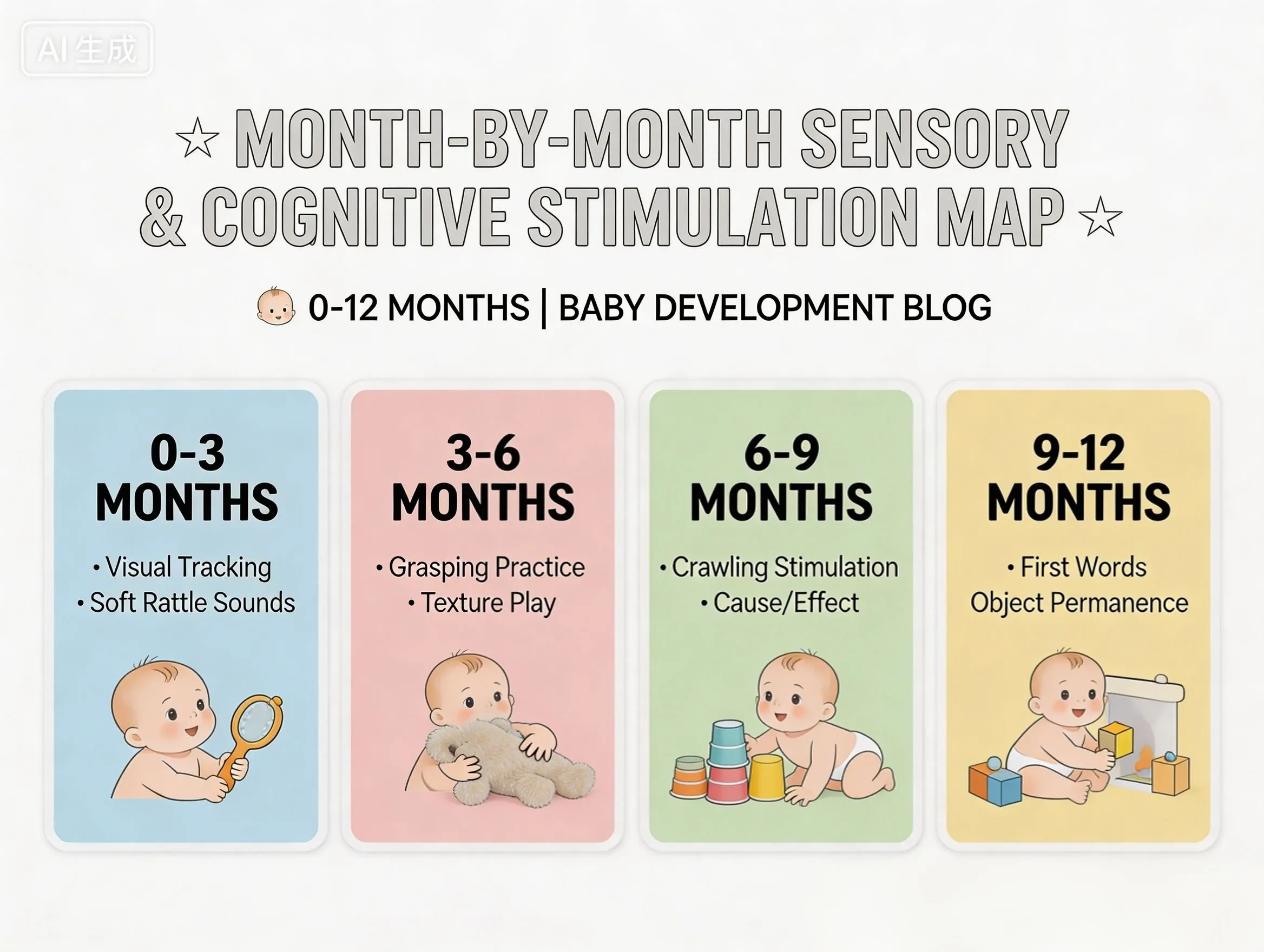
Month-by-Month Sensory & Cognitive Stimulation Map (0-12 Months)
- Published on
- //4 mins read/––– views
Early sensory and cognitive development does not require expensive toys or complicated curricula. Babies learn fastest through repeated, responsive interaction with caregivers in ordinary daily routines.
This guide gives a month-by-month map from 0 to 12 months so parents can support development without overloading babies.
How to use this map
Use each month as a directional guide, not a strict checklist.
Focus on:
- repeated short interactions
- reading baby cues
- safe movement/play opportunities
- trend-based progress over weeks
0-2 months: regulation and orientation
Common developmental focus
- visual focus at close range
- startle and sound orientation
- calming through voice, touch, and routine
Practical home activities
- 1-3 minute face-to-face talk windows
- gentle tracking with high-contrast targets
- skin-to-skin and soothing touch routines
Parent cue
If baby looks away, yawns, arches, or fusses, reduce stimulation and reset.
3-4 months: early interaction loops
Common developmental focus
- longer alert windows
- stronger social smiling and vocal response
- improved head/trunk control
Practical home activities
- turn-taking coo conversations
- supervised tummy-time progression
- simple song + gesture routines
Parent cue
Quality of responsive interaction matters more than activity duration.
5-6 months: exploration launch
Common developmental focus
- reaching, grasping, mouthing exploration
- rolling attempts and body experimentation
- richer voice and expression patterns
Practical home activities
- safe texture play with one sensory focus at a time
- object transfer games hand-to-hand
- narrated play (“you grabbed the ball!”)
Parent cue
Repetition is learning, not boredom.
7-9 months: mobile learning phase
Common developmental focus
- floor mobility growth (scoot/crawl/pivot variants)
- stronger object permanence behaviors
- social referencing and communication intent
Practical home activities
- safe floor pathways and obstacle exploration
- hide-and-find simple object games
- gesture-word pairing (“more,” “up,” “bye”)
Parent cue
Childproofing now directly supports developmental learning time.
10-12 months: problem-solving and shared attention growth
Common developmental focus
- cruising/standing transitions
- imitation and cause-effect understanding
- joint attention and intentional gestures
Practical home activities
- container fill-empty and simple cause-effect toys
- shared book pointing and naming
- imitation routines (clap, wave, stack)
Parent cue
Development remains domain-specific; early motor speed does not equal universal advanced timing.
Daily structure that works (all ages)
Use this low-pressure rhythm:
- 3-6 short responsive play windows daily
- supervised movement/floor time
- language-rich routines during care moments
- calm low-stimulation transitions before sleep
Consistency beats intensity.
Overstimulation signs and reset method
Common signs:
- gaze aversion
- escalating fussiness
- stiff/arching body pattern
- harder settling after play
Reset:
- reduce noise/light input
- hold and slow pace
- return to one low-intensity cue (voice/touch)
- pause activity and allow recovery
Common misconceptions
Misconception 1: “More toys means faster cognitive growth”
Caregiver responsiveness and repeated interaction are usually higher-impact.
Misconception 2: “Development needs rigid daily training blocks”
Short frequent routines integrated into real life are often more sustainable and effective.
Misconception 3: “If one milestone is late, everything is delayed”
Domains progress unevenly; watch patterns over time.
Misconception 4: “Screens can replace early interaction”
Infants learn best from real-world human interaction.
When to consult your pediatric clinician
Reach out for persistent concerns such as:
- limited social engagement trajectory
- little movement/communication progression across weeks
- unusual asymmetry or tone concerns
- loss of previously observed skills
- feeding/growth concerns with developmental worries
FAQ
How long should sensory-cognitive play sessions be?
Usually brief and frequent sessions work best, especially in early months.
Do I need special developmental toys?
Not necessarily. Safe household items + responsive interaction can be highly effective.
Is skipping one day of structured play harmful?
No. Trends matter more than one day.
What is the most effective daily practice?
Warm, responsive interaction with language and safe exploration opportunities.
References
- CDC: Developmental milestones
- CDC: Milestones by 2 months
- CDC: Milestones by 4 months
- CDC: Milestones by 6 months
- CDC: Milestones by 9 months
- CDC: Milestones by 1 year
- UNICEF Parenting: How babies learn through play
- UNICEF: Learning through play (UNICEF + LEGO Foundation)
- WHO: Improving early childhood development guideline
- WHO: ECD guideline summary
Final takeaway
From 0 to 12 months, sensory and cognitive growth is best supported by simple daily responsive interaction, safe exploration, and calm regulation—not stimulation overload or perfect schedules.