
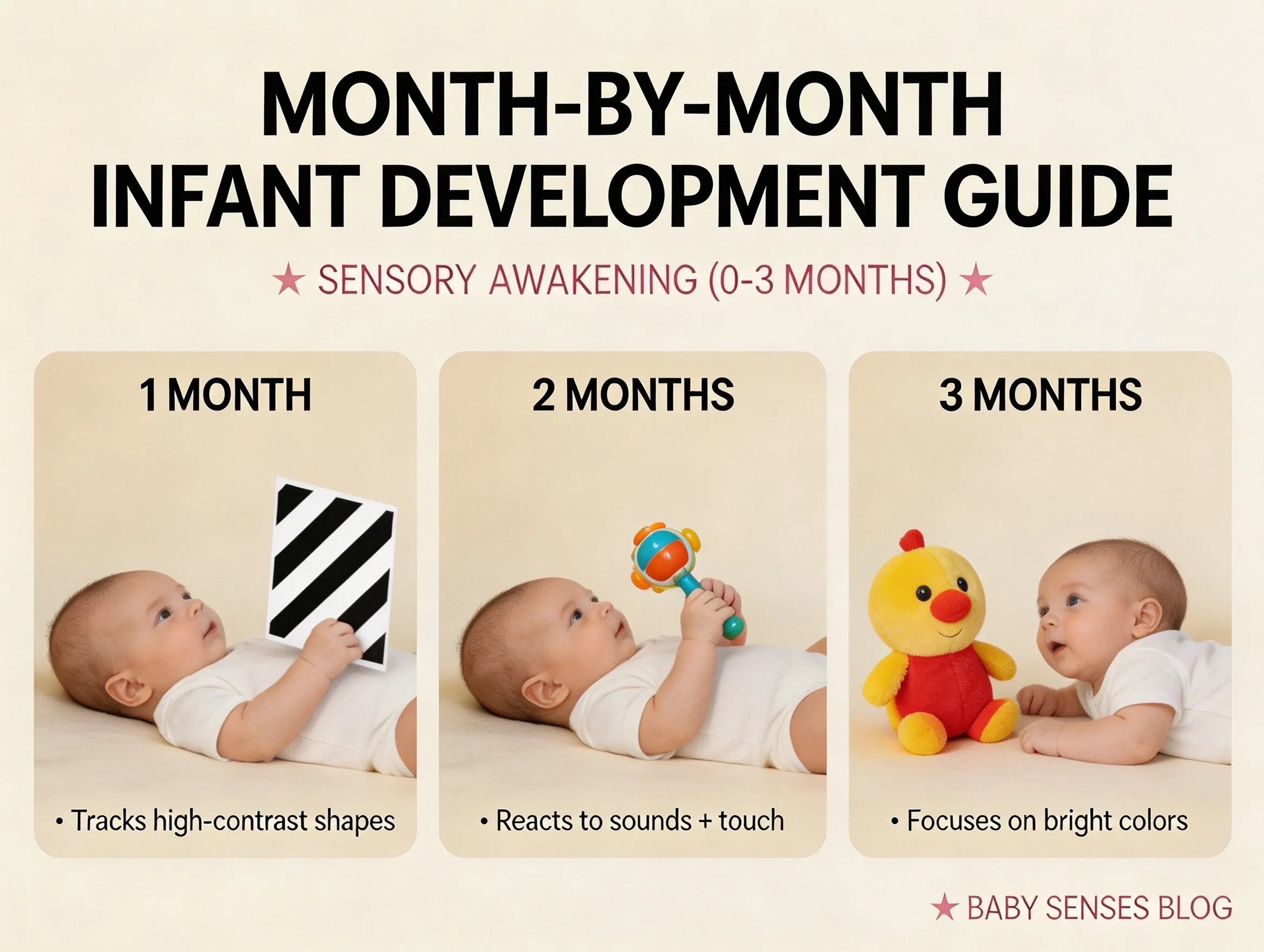
Month-by-Month Infant Development Guide: Sensory Awakening (0-3 Months)
- Published on
- //5 mins read/––– views
The first three months can feel mysterious. Parents often ask: "Is my baby seeing enough? hearing enough? responding enough?"
This guide focuses on the sensory awakening phase from 0-3 months, using practical observations and evidence-based guidance from trusted pediatric and public-health sources.
Important: development is a range, not a race. Use this article for orientation, not diagnosis.
Why the 0-3 month sensory window matters
In early infancy, the brain is building rapid connections through repeated, safe, responsive interactions. Vision, hearing, touch, smell, and movement systems are developing together.
What helps most is not expensive stimulation tools. It is consistent, calm caregiving:
- eye contact
- voice interaction
- touch and comfort
- predictable routines
- supervised awake movement opportunities
Month 0-1: orientation and regulation
What you may notice
- Baby startles to sudden sounds
- Prefers close faces (especially at short distances)
- Calms with familiar voice/smell
- Uses crying and body tension as main communication
Sensory support that works
- Hold baby close and speak slowly with warm facial expression
- Use high-contrast visual targets briefly
- Prioritize skin-to-skin and soothing touch
- Keep stimulation short; newborns fatigue quickly
Parent checkpoint
At this stage, frequent sleep and variable alertness are expected. Short, meaningful interactions matter more than long activity sessions.
Month 1-2: emerging social sensing
What you may notice
- Longer alert windows
- More attention to faces and voice rhythm
- Early social engagement signals (brief smiles, facial tracking)
- Strong preference for caregiver presence and familiar patterns
Sensory support that works
- Narrate care routines (diapering, feeding, bathing)
- Pause to let baby "answer" with sounds or facial cues
- Gentle, supervised tummy time while awake
- Keep environment engaging but not chaotic (one stimulus at a time)
Parent checkpoint
Baby may not respond consistently in every interaction. Variability is common.
Month 2-3: stronger tracking and interaction
What you may notice
- Better visual tracking of moving faces/objects
- More vocal sounds (cooing patterns)
- Stronger orientation to familiar voices
- Increased hand-to-mouth exploration and body awareness
Sensory support that works
- Use face-to-face play with simple expressions and pauses
- Offer safe sound variation (soft singing, gentle rattles)
- Continue daily supervised tummy time progression
- Rotate simple textures during calm awake periods (soft cloth, gentle touch)
Parent checkpoint
Development still unfolds unevenly. One domain may appear to "jump" before another.
A practical weekly sensory routine (0-3 months)
You do not need a rigid schedule. Try this framework:
- Daily: 3-5 short face-and-voice sessions (1-3 minutes each)
- Daily: supervised awake tummy time, increasing gradually as tolerated
- Daily: calm touch routine (after bath or before sleep)
- Daily: low-noise recovery periods to avoid overstimulation
Consistency beats intensity.
Signs of overstimulation (and how to reset)
Babies at this age can become overloaded quickly.
Common signs:
- gaze aversion
- finger splaying, back arching, fussing escalation
- hiccups/yawning during active play
- harder settling after stimulation
Reset method:
- Reduce noise/light input
- Hold baby close
- Slow your voice and movement
- Pause activity and allow recovery
When to discuss with your pediatric clinician
Contact your pediatric team if you consistently notice concerns such as:
- limited response to sound
- absent or very limited visual engagement over time
- persistent feeding/soothing difficulty with developmental concerns
- major asymmetry in movement or very unusual tone patterns
- loss of previously observed behaviors
A single off day is usually not the signal. Repeated pattern concerns are.
Common misconceptions parents carry
Misconception 1: "More stimulation means faster development"
Too much input can dysregulate young infants. Regulation and responsiveness come first.
Misconception 2: "If milestones are not exact by date, something is wrong"
Milestones describe typical ranges. Individual timing varies.
Misconception 3: "I need expensive sensory toys"
Caregiver face, voice, touch, and safe positioning are often the highest-value tools.
Misconception 4: "Tummy time is optional if baby dislikes it"
Supervised awake tummy time remains important; build gradually in brief, tolerable intervals.
FAQ
How long should sensory play be for a newborn?
Short sessions are best—often 1-3 minutes, repeated through the day when baby is calm and alert.
Can I compare my baby’s progress to social media videos?
It is better to compare with evidence-based milestone ranges and your child’s own trajectory.
What is the best sensory activity at 0-3 months?
Face-to-face interaction with voice, touch, and responsive pauses is foundational and highly effective.
Should I worry if my baby has variable responses day to day?
Day-to-day variability is normal. Seek advice when a concern is persistent and pattern-based.
References
- CDC: Milestones by 2 months
- CDC: Milestones by 4 months
- CDC: Milestones in Action (2 months)
- NHS: Getting to know your newborn
- NHS: Baby’s first sounds (0 to 6 months)
- NHS: Newborn hearing screening
- AAP HealthyChildren: How your newborn behaves
- AAP HealthyChildren: Infant vision development
- AAP HealthyChildren: Back to Sleep, Tummy to Play
- WHO guideline: Improving early childhood development
- NCBI Bookshelf: WHO guideline evidence and recommendations
- UNICEF: Early Moments Matter
- PubMed (2024): early visual function and cognitive outcomes review
- PubMed (2024): early postnatal auditory stimulation review
Final takeaway
From 0-3 months, sensory development grows through everyday caregiving: calm voice, close contact, safe movement, and responsive routines. Focus on consistent connection, watch patterns over time, and reach out early when concerns persist.