
Gentle Sleep Training Methods: Pick-Up/Put-Down vs The Chair Method and Other Low-Pressure Approaches
- Published on
- //6 mins read/––– views
Many parents want better sleep, but do not want rigid or high-distress methods. That is where gentle sleep training approaches can help: lower-pressure, responsive strategies that build sleep skills over time.
This guide compares practical non-forceful methods—including Pick-Up/Put-Down and the Chair Method—and shows how to choose based on your baby, your family bandwidth, and your goals.
Important: this is educational content and not a medical diagnosis or individualized treatment plan.
What “gentle sleep training” usually means
In practice, gentle sleep training usually includes:
- consistent bedtime structure
- caregiver presence and responsive support
- gradual reduction of sleep assistance
- avoiding abrupt all-or-nothing changes
It does not mean there is zero crying in every case. It means the strategy prioritizes responsiveness, pacing, and emotional safety while still helping the child learn independent sleep skills.
Before starting: readiness and safety checks
Gentle methods work better when timing and setup are right.
Quick readiness checklist:
- sleep environment follows safe-sleep guidance
- feeding concerns, reflux concerns, and acute illness are addressed
- bedtime and wake times are reasonably consistent
- caregivers agree on the approach for at least 1-2 weeks
If there are persistent medical, breathing, growth, or developmental concerns, discuss with your pediatric clinician before starting behavior-focused sleep changes.
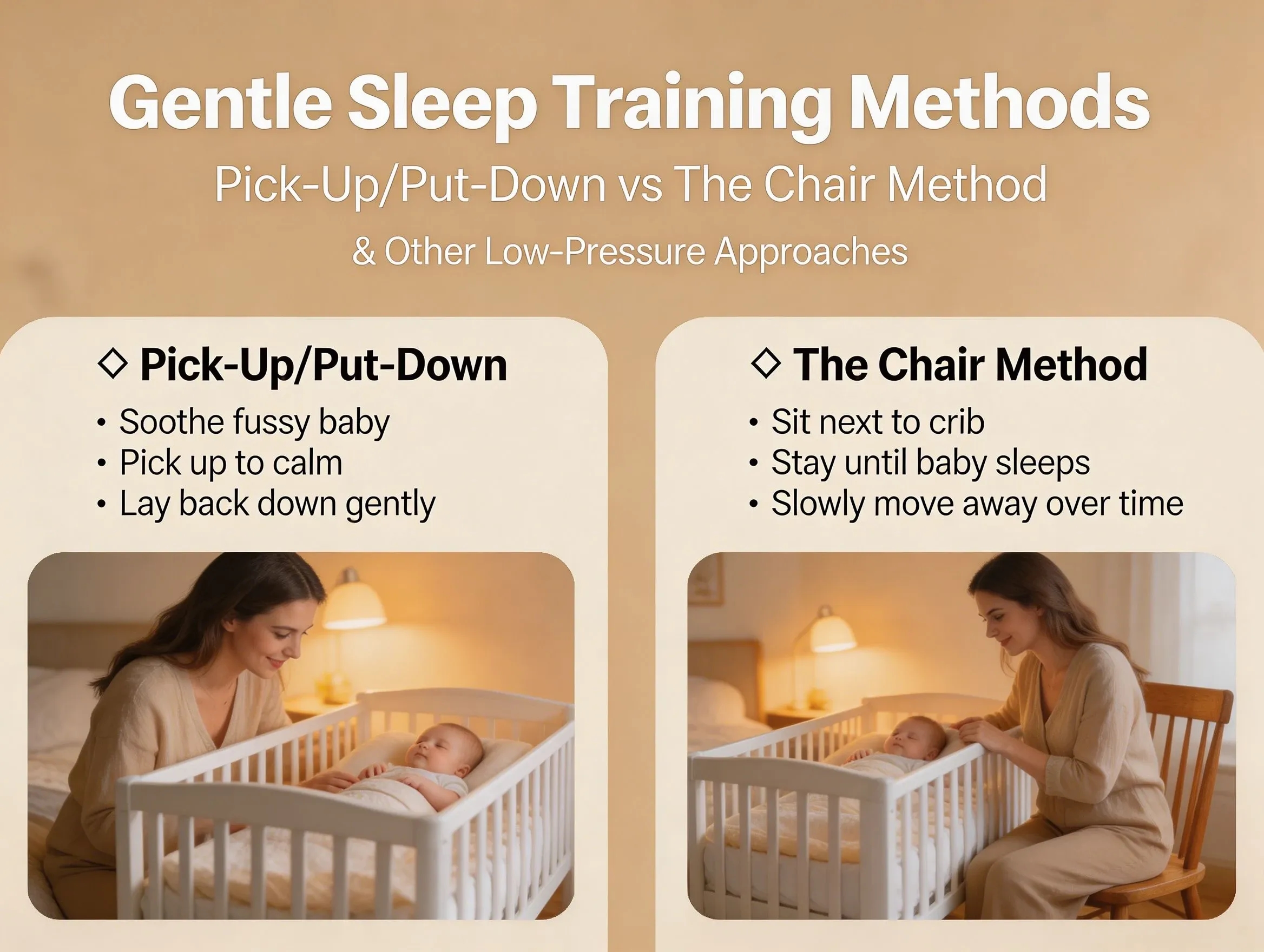
Method 1: Pick-Up/Put-Down (PUPD)
Core idea
When baby is upset, you pick up briefly to calm, then put down awake. Repeat as needed.
Best-fit scenarios
- families who want high responsiveness
- infants who escalate quickly without contact
- caregivers who can tolerate repeated short cycles
Strengths
- emotionally aligned for parents who prefer immediate soothing
- builds association between crib and sleep with caregiver support
Limits
- physically demanding
- can become overstimulating in older or highly alert babies if repeated too frequently
Practical tips
- use short calming pickups (not full re-settling every time)
- keep lights low and interaction minimal at bedtime/night wakings
- pair with strong routine cues so not every settling attempt starts from zero
Method 2: The Chair Method (gradual withdrawal)
Core idea
Caregiver sits near crib during sleep onset, offering verbal/touch reassurance with minimal picking up, then gradually increases distance over days.
Best-fit scenarios
- babies who settle better with visible caregiver presence
- caregivers wanting a structured step-down plan
- families seeking less physical intensity than PUPD
Strengths
- clear progression plan
- often easier consistency across multiple caregivers
Limits
- may involve protest while caregiver is visible but less interactive
- progress can stall if movement between steps is too fast
Practical tips
- define step plan in advance (e.g., cribside -> mid-room -> doorway -> outside)
- stay at each step several nights before advancing if distress remains high
- keep bedtime routine and wake windows stable while method is underway
Other non-forceful approaches families use
Bedtime fading
Shift bedtime temporarily later to match natural sleep onset, then gradually move earlier once sleep onset becomes smoother.
Responsive routine shaping
Strengthen pre-sleep cues, reduce sleep associations gradually, and respond with predictable low-stimulation support.
Timed check-ins with low stimulation
Some families use brief timed reassurance intervals as a middle ground, with calm verbal support and minimal handling.
No single method is universally best. Fit and consistency matter more than labels.
Pick-Up/Put-Down vs Chair Method: side-by-side comparison
Emotional load
- PUPD: high immediate responsiveness, high caregiver effort
- Chair: steady presence, lower physical effort, potentially longer protest phases
Consistency demands
- PUPD: high consistency in how/when pickup happens
- Chair: high consistency in distance-step progression
Typical friction points
- PUPD: repeated pick-up loops can prolong bedtime in some babies
- Chair: visible caregiver without full intervention can frustrate some babies initially
Who may prefer each
- PUPD: parents who prioritize immediate soothing contact
- Chair: parents who prefer a clear gradual-withdrawal roadmap
How to avoid common gentle-training pitfalls
Pitfall 1: changing methods every 2-3 nights
Most methods need at least 7-14 days of consistent application before fair evaluation.
Pitfall 2: changing too many variables at once
Keep core anchors stable:
- wake time
- bedtime routine
- response pattern
Pitfall 3: starting during high disruption windows
Travel, illness, major schedule disruption, or developmental leaps can temporarily reduce success.
Pitfall 4: ignoring caregiver capacity
A method that looks ideal on paper fails if caregivers cannot sustain it.
A practical 14-day gentle sleep plan
Days 1-3: baseline and setup
- set fixed wake window anchors
- simplify bedtime routine (20-30 minutes)
- agree response script across caregivers
Days 4-10: implement one chosen method
- keep response pattern consistent
- track settling time, number of wake-ups, and caregiver burden
- avoid method switching unless distress is extreme or medical concerns emerge
Days 11-14: adjust with data
- if trend is improving, continue
- if no improvement, modify one variable (timing, response intensity, nap balance)
- seek pediatric guidance when concerns persist
What evidence says (without overclaim)
Behavioral sleep interventions have evidence for improving infant sleep outcomes and parental wellbeing in many families. Evidence also suggests that multiple approaches can be effective, not just one strict method.
The strongest real-world predictor is often not the brand name of the method, but fit + consistency + responsive implementation.
When to involve a pediatric clinician early
Reach out sooner if you notice:
- persistent snoring, labored breathing, or apneic concerns
- poor growth/feeding concerns with sleep difficulties
- severe caregiver exhaustion affecting safety
- signs of medical discomfort during settling (pain, reflux red flags)
- no meaningful improvement despite consistent implementation and appropriate timing
FAQ
Is gentle sleep training the same as “no cry” sleep training?
Not exactly. Gentle approaches reduce intensity and emphasize responsiveness, but some protest can still occur.
Which is gentler: Pick-Up/Put-Down or Chair Method?
It depends on baby temperament and caregiver tolerance. Both can be gentle when applied responsively.
How long should we try one method before switching?
Usually 1-2 weeks of consistent implementation gives a fair signal unless major distress or medical concerns appear.
Can we combine methods?
Yes, but combine intentionally and keep core response logic consistent to avoid confusing sleep cues.
References
- AAP HealthyChildren: Getting Your Baby to Sleep
- AAP HealthyChildren: Self-Soothing
- AAP Pediatrics: Behavioral Interventions for Infant Sleep Problems (RCT)
- PubMed: Behavioral Interventions for Infant Sleep Problems (RCT)
- PubMed: Behavioral infant sleep intervention and maternal outcomes
- PubMed: Behavioral treatment of bedtime problems and night wakings
- PubMed: Practice parameters for behavioral treatment in young children
- NHS: Helping your baby to sleep
- WHO: Nurturing care for early childhood development framework
- WHO: Nurturing care practice guide
Final takeaway
Gentle sleep training is less about finding a perfect branded method and more about choosing a low-pressure, evidence-informed approach your family can apply consistently. Start with safety and readiness, pick one method, track trends for 1-2 weeks, and adjust with support when needed.