
Joint Attention and Early Language: Why Shared Focus Is a Powerful Infant Learning Tool
- Published on
- //3 mins read/––– views
Before babies speak words, they learn through shared focus: looking at the same object with a caregiver, noticing labels, and taking turns in interaction.
This process—often called joint attention—is a foundational bridge between sensory input, cognition, and language.
What joint attention looks like in real life
Common patterns:
- baby looks at object, then caregiver
- caregiver points/names, baby reorients
- repeated back-and-forth around one shared target
This is more than "looking together"; it trains communication timing and meaning mapping.
Why shared focus supports language
Joint attention helps babies:
- connect words to objects/actions
- practice turn-taking communication
- build social learning and prediction
- strengthen memory through repeated context
The strongest language input is interactive, not one-way exposure.
Age-appropriate shared-focus activities
0-3 months
- face tracking with slow voice cues
- pause-and-respond vocal imitation
- naming during care routines
4-6 months
- single toy + repeated naming
- mirror interaction with emotion labels
- song gestures with pauses for response
7-9 months
- point-and-name around room routines
- object hide/reveal naming
- turn-taking sound games
10-12 months
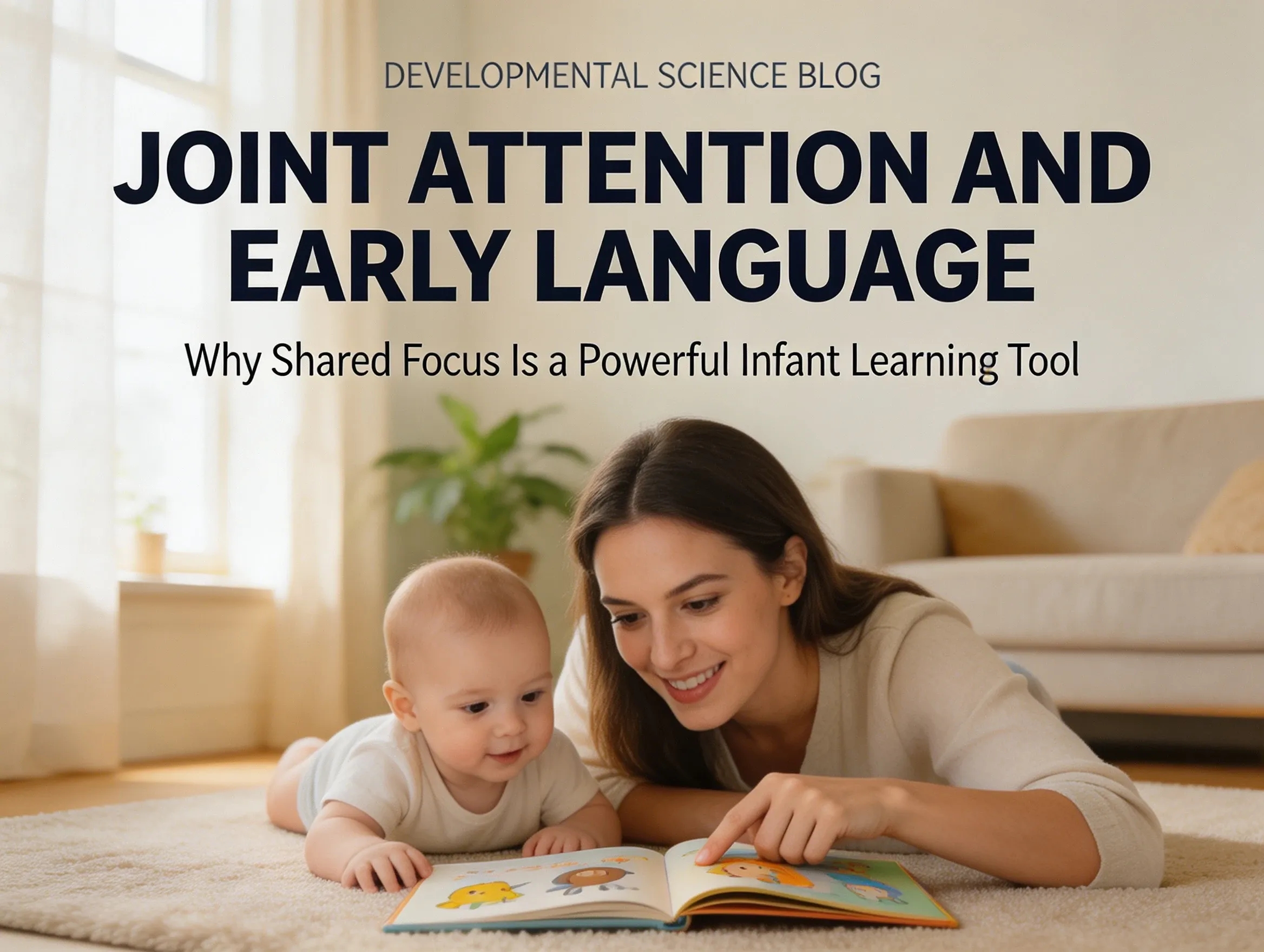
- board-book point-and-label sessions
- “show me” object routines
- gesture-word pair loops (up/more/bye)
Shared reading as a joint-attention tool
Shared reading in infancy is not about early academic pressure. It is about:
- warm interaction
- repeated labeling
- rhythm, attention, and turn-taking
Short daily reading moments can produce large cumulative language input over months.
How to improve quality quickly
Use the 4-step loop:
- follow baby’s gaze/interest
- label briefly (1-3 words)
- pause for response
- respond and repeat
This loop is simple, portable, and highly effective.
Common mistakes
Mistake 1: talking too long without pauses
Babies need turn-taking space, not continuous monologue.
Mistake 2: switching targets too quickly
Sustained shared focus on one target builds stronger mapping.
Mistake 3: replacing interaction with passive media
Real-time human response is the core learning engine.
Mistake 4: waiting for words before language support
Language foundations begin before first words.
When to seek professional advice
Discuss with your pediatric clinician if you notice persistent concerns such as:
- low social engagement trend
- limited eye-contact/shared-focus behaviors over time
- reduced responsiveness to voice and interaction
- broader developmental concerns across domains
Early support improves trajectory and parent confidence.
FAQ
Is joint attention the same as eye contact?
Not exactly. Eye contact can be part of it, but joint attention includes shared focus on people/objects/events.
How long should activities be?
Short frequent sessions (1-5 minutes) are often best.
Can daily reading really help before talking starts?
Yes. Shared reading strengthens early language pathways well before first words.
What matters most: toy quality or interaction quality?
Interaction quality usually matters more.
References
- HealthyChildren: Shared reading from infancy offers lifelong benefits
- AAP: Early literacy
- AAP: Early relational health interventions and referrals
- CDC: Developmental milestones
- UNICEF Parenting: How babies learn through play
- WHO: Nurturing care
Final takeaway
Joint attention is one of the highest-value early-language tools parents can use: follow baby’s focus, label simply, pause, and respond. Small daily loops build large long-term gains.