
The Neonatal Reflex Inventory: Understanding Your Baby's Hardwired Survival Instincts
- Published on
- //6 mins read/––– views
If you have ever seen your newborn fling their arms wide during sleep, latch quickly when a cheek is touched, or grip your finger with surprising strength, you have seen neonatal reflexes in action.
These are not random movements. They are built-in, automatic patterns wired into the early nervous system. For parents, understanding reflexes can reduce anxiety: many behaviors that look dramatic are normal, expected, and temporary.
This guide gives you a practical "reflex inventory" you can use at home, while also clarifying when to seek professional assessment.
What neonatal reflexes are (and why they matter)
Neonatal reflexes—often called primitive reflexes—are involuntary responses to specific stimuli. They support early survival functions such as feeding, protection, orientation, and motor organization.
Clinicians also use reflex patterns as part of newborn neurological assessment. Reflexes are interpreted together with tone, symmetry, feeding, alertness, and overall clinical context.
Key point: one movement alone rarely tells the whole story. Patterns over time matter more.
The neonatal reflex inventory: what parents should know
1) Rooting reflex
What it looks like: Touching the corner of your baby's mouth or cheek causes the head to turn toward that side and the mouth to open.
Why it helps: Supports finding the breast or bottle nipple.
When it fades: Typically weakens over early months as voluntary feeding control improves.
2) Sucking reflex
What it looks like: When something touches the roof of the mouth, baby starts rhythmic sucking.
Why it helps: Essential for feeding and early self-regulation.
When it changes: Becomes less reflex-dominant as feeding becomes more coordinated and purposeful.
3) Moro (startle) reflex
What it looks like: Sudden noise or positional change can trigger extension of arms/legs, then a quick return inward, often with crying.
Why it helps: Protective arousal response in early life.
When it fades: Usually decreases over the first months and is often gone by around 4–6 months.
4) Palmar grasp reflex
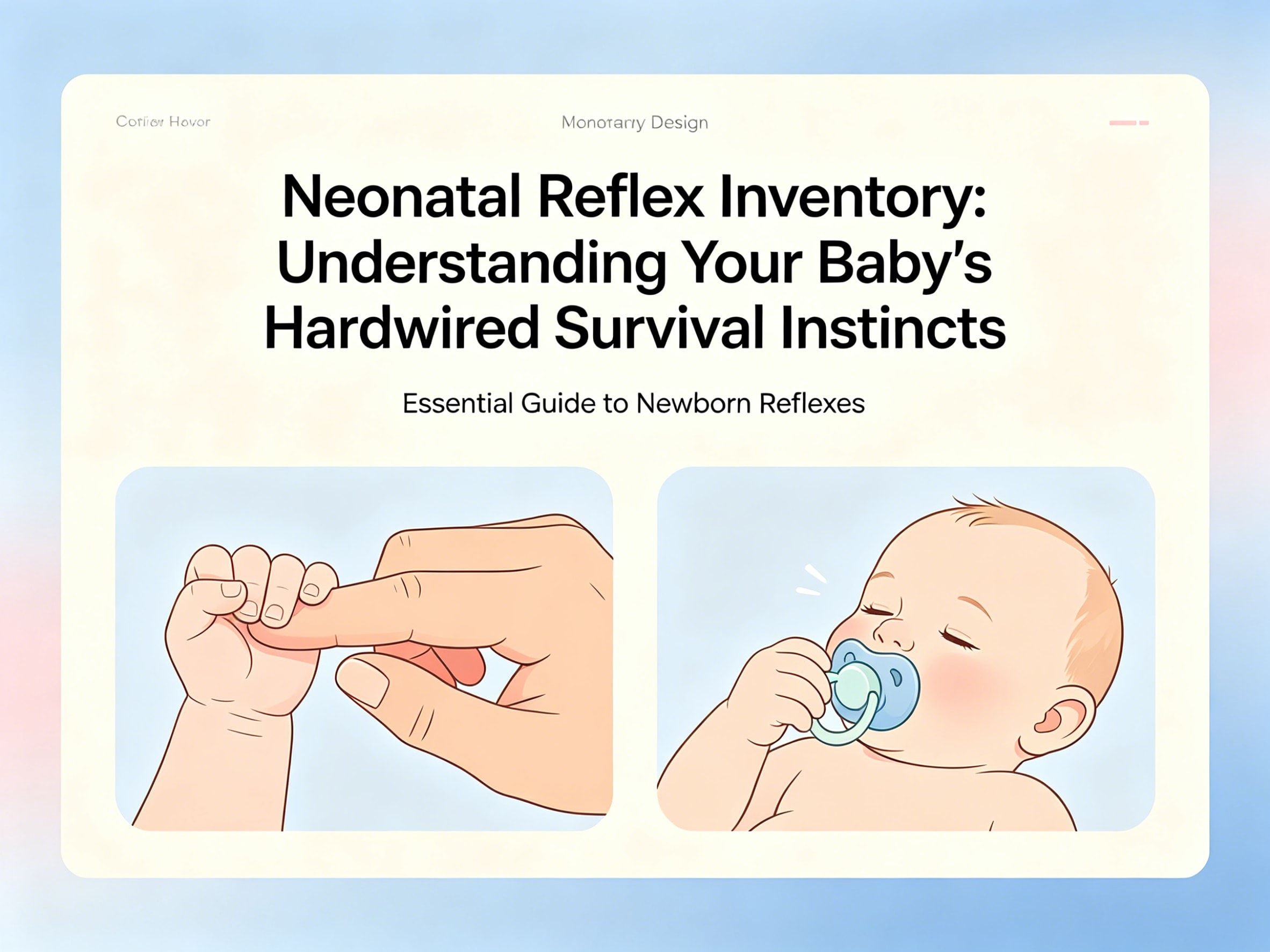
What it looks like: A finger in baby's palm triggers a strong grip.
Why it helps: Early sensorimotor patterning and hand awareness.
When it fades: Gradually integrates as voluntary grasp develops.
5) Tonic neck ("fencer") reflex
What it looks like: With head turned to one side, the arm/leg on that side may extend while opposite limbs flex.
Why it helps: Early postural organization and visual-motor orientation.
When it fades: Commonly integrates during infancy as motor control matures.
6) Stepping reflex
What it looks like: With feet touching a firm surface while supported upright, baby makes stepping-like motions.
Why it helps: Early locomotor circuitry expression.
When it changes: Usually diminishes before later voluntary walking patterns emerge.
Why these reflexes can look alarming at home
Many parents worry because reflexes appear sudden and intense, especially the Moro reflex.
Common concerns include:
- "My baby jerks in sleep—could this be a seizure?"
- "The startle reaction seems so dramatic—is something wrong?"
- "One side looks stronger than the other—is this normal?"
Most of the time, typical startle episodes are brief, trigger-linked, and followed by normal settling with feeding/soothing support. But persistent asymmetry, missing expected reflexes, or concern about abnormal movements should be discussed with a pediatric professional.
What parents often misunderstand about newborn reflexes
Misunderstanding 1: "Strong reflexes mean advanced development"
Not necessarily. Reflexes are expected automatic responses, not a "giftedness" score.
Misunderstanding 2: "If a reflex disappears, something is wrong"
Integration is expected. Many primitive reflexes should reduce over time as voluntary control increases.
Misunderstanding 3: "I can test reflexes repeatedly at home"
Frequent stimulation can stress or overstimulate infants. Observation during normal care is usually enough.
Misunderstanding 4: "Any startle = emergency"
Startle reflexes are common. Urgency depends on the full clinical picture, especially breathing changes, persistent abnormal movements, poor feeding, or altered responsiveness.
Practical home observation checklist (non-diagnostic)
Use this as a conversation aid for clinic visits, not as a diagnosis tool.
- Do responses seem present on both sides?
- Are patterns broadly consistent with age expectations?
- Is feeding effective and improving?
- Does baby recover and settle after startle?
- Are there persistent concerns: one-sided absence, unusual stiffness/floppiness, repeated concerning episodes?
If yes to persistent concerns, document what you see (time, trigger, duration, recovery) and contact your clinician.
Red flags: when to contact your pediatric team promptly
Seek professional guidance if you notice:
- clear asymmetry (one side consistently absent or much weaker)
- reflexes that seem absent when they are expected in a newborn exam context
- persistence of primitive reflex patterns well beyond expected windows
- episodes you cannot link to normal triggers, especially with color change, breathing difficulty, or poor responsiveness
- feeding decline, weak suck, or poor weight gain with neurological concerns
When worried, trust that instinct. Early evaluation is usually the safest path.
How this fits into modern newborn care (2024-2026 context)
Recent pediatric and developmental guidance increasingly emphasizes:
- milestone tracking with clear parent-facing tools
- earlier identification of developmental concerns
- combining parent observations with structured clinical neurological assessment
- avoiding online overdiagnosis while improving access to early support
In short: reflex knowledge is most useful when it reduces fear and improves timely communication with clinicians.
FAQ
Are neonatal reflexes the same as deliberate movement?
No. Reflexes are automatic responses. Deliberate motor control develops gradually over infancy.
Can I diagnose a neurological problem by checking reflexes at home?
No. Home observations are helpful, but diagnosis requires professional examination and context.
Is Moro reflex during sleep always abnormal?
Usually not. Startle-like movements can be common in newborn sleep. What matters is pattern, severity, and associated warning signs.
Do all babies lose reflexes at the exact same age?
No. There is normal variation. Clinicians evaluate trends and the whole developmental profile.
References
- AAP HealthyChildren: Newborn Reflexes
- MedlinePlus Medical Encyclopedia: Infant reflexes
- MedlinePlus Medical Encyclopedia: Moro reflex
- Merck Manual Professional: Physical Examination of the Newborn
- Merck Manual table: Three Common Reflexes of Newborns
- CDC: Milestones by 2 Months
- StatPearls (NCBI Bookshelf): Primitive Reflexes
- StatPearls (NCBI Bookshelf): Rooting Reflex
- PubMed: Hammersmith Infant Neurological Examination subscores and cerebral palsy prediction (2024)
- PubMed: Brief-Hammersmith Infant Neurological Examination (2024)
Final takeaway
Neonatal reflexes are your baby's built-in early survival and organization tools. Most are expected and temporary. The goal for parents is not to "test" every reflex, but to notice patterns, support feeding and comfort, and escalate concerns early when something feels off.