
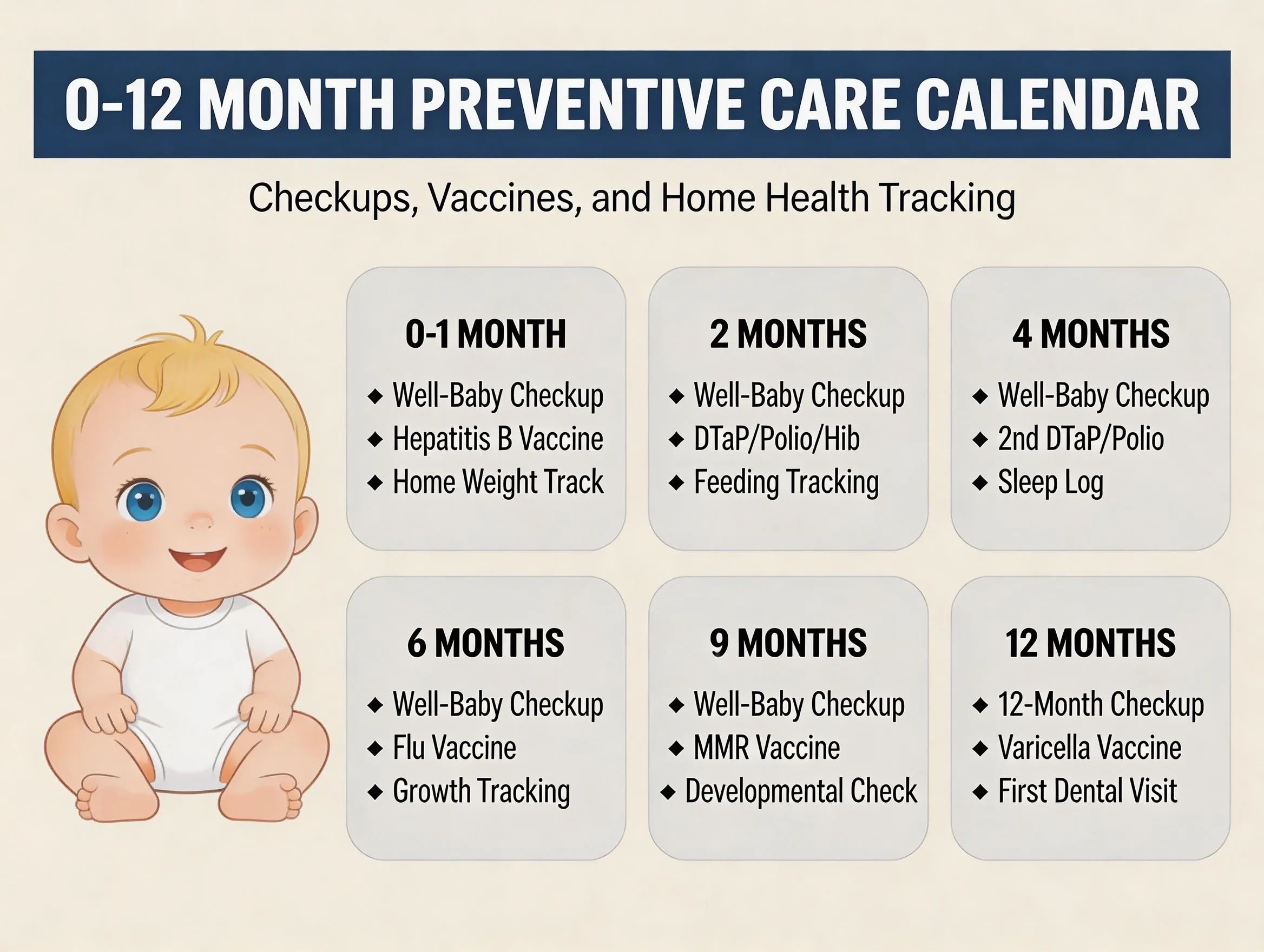
0-12 Month Preventive Care Calendar: Checkups, Vaccines, and Home Health Tracking
- Published on
- //4 mins read/––– views
The first year includes many health touchpoints, and parents often feel overwhelmed by visit timing, vaccine logistics, and milestone questions.
This preventive-care calendar helps families organize what matters most from birth to 12 months.
Important: local schedules vary by country/region and medical history. Always follow your clinician’s advice and local public-health schedule.
Why a preventive-care calendar reduces stress
A clear plan helps families:
- avoid missed well-child visits
- stay current on recommended vaccines
- detect growth/development concerns earlier
- coordinate caregiving across households
Prevention is easier when routine systems are in place before problems appear.
First-year visit timeline (typical pattern)
Common preventive visits include:
- newborn period (early post-discharge follow-up)
- around 1 month
- around 2 months
- around 4 months
- around 6 months
- around 9 months
- around 12 months
At each visit, clinicians typically review growth, feeding, sleep, development, safety, and vaccine status.
What to prepare before each checkup
Bring a short checklist:
- feeding pattern and recent changes
- urine/stool pattern notes
- sleep pattern summary
- current medications/supplements
- illness history since last visit
- your top 3 caregiver questions
This turns visits into high-value decision points.
Vaccine planning in the first year
General principles:
- vaccines are scheduled across the first year to protect early against serious infections
- timing and products differ by country and risk profile
- missed doses are common and usually recoverable via catch-up plans
Keep one source of truth:
- clinic chart + parent copy/photo + digital reminder calendar
Developmental monitoring: what to track at home
Use milestone tracking as a trend tool, not a pass/fail exam.
Track across domains:
- movement
- social interaction
- communication
- problem-solving/play
- feeding and regulation
Share patterns with your clinician at each visit, especially if concerns repeat across weeks.
Home health dashboard (simple template)
Use monthly snapshots with five lines:
- weight/length/head growth updates from visits
- feeding pattern summary
- sleep rhythm summary
- milestones observed
- concern flags and follow-up actions
This lightweight record improves continuity across caregivers and appointments.
Red flags that should not wait for next routine visit
Seek earlier review for persistent concerns such as:
- feeding decline with poor growth trend
- repeated breathing concerns
- major hydration concerns
- developmental regression (loss of previously acquired skills)
- sustained low engagement or unusual behavior shifts
One difficult day is common. Repeated patterns need timely assessment.
Common misconceptions
Misconception 1: “If baby seems fine, routine visits can be delayed”
Preventive visits are for early detection, not only visible illness.
Misconception 2: “Milestones must appear exactly on one date”
Milestones represent ranges. Patterns over time are more informative.
Misconception 3: “A missed vaccine means we failed permanently”
Catch-up strategies are often available—contact your clinician promptly.
Misconception 4: “I can remember everything without tracking”
Simple logs improve care quality and reduce missed details.
FAQ
How many checkups are typical in the first year?
Most schedules include multiple preventive visits from newborn period through 12 months.
Should I delay visits if my baby seems healthy?
Routine visits are still important for prevention and monitoring.
What is the most useful thing to bring to appointments?
A concise symptom/feeding/sleep/milestone note from the past few weeks.
Can developmental concerns wait until next scheduled checkup?
If concerns are persistent or worsening, seek earlier review.
References
- CDC: Developmental monitoring and screening
- CDC: Developmental Milestones
- CDC: Child and adolescent immunization schedules
- AAP: Preventive care periodicity schedule
- HealthyChildren: Your child’s checkups
- HealthyChildren: 2-month checkup checklist
- HealthyChildren: 4-month checkup checklist
- HealthyChildren: 6-month checkup checklist
- HealthyChildren: 9-month checkup checklist
- HealthyChildren: 12-month checkup checklist
- MyHealthfinder: Make the most of your baby’s doctor visit
Final takeaway
A first-year preventive-care calendar gives parents structure: keep visits on time, track vaccines and development consistently, and escalate persistent concerns early instead of waiting for the next routine appointment.