
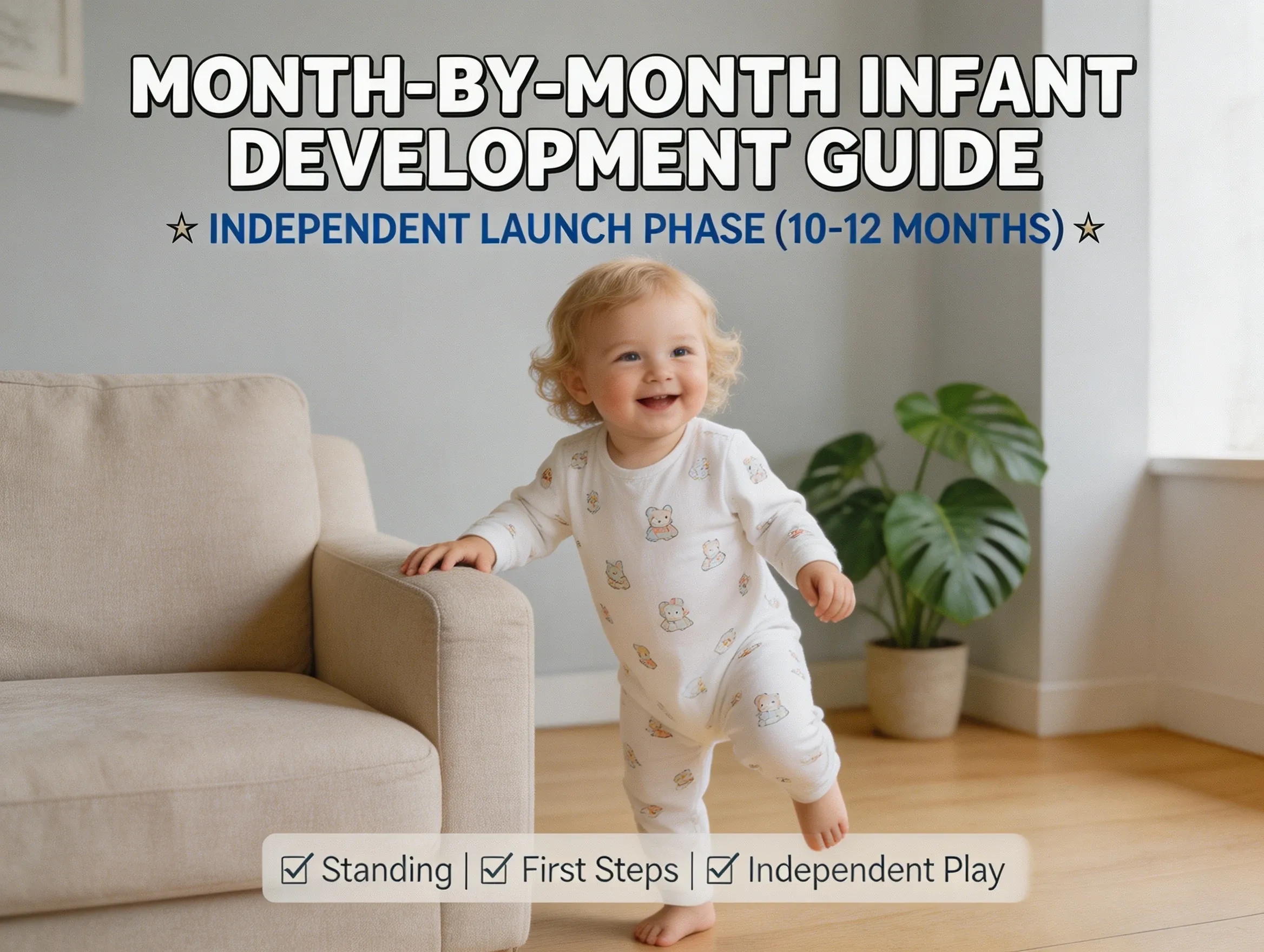
Month-by-Month Infant Development Guide: Independent Launch Phase (10-12 Months)
- Published on
- //6 mins read/––– views
From 10 to 12 months, many babies move from broad exploration into an "independent launch" period: they test balance, decision-making, communication intent, and social problem solving at much higher speed.
This stage often feels exciting and intense for families. One week your baby is cruising along furniture; the next week they are climbing, pointing, and protesting with clear purpose.
This guide helps you track month-by-month progress patterns at home without turning development into a race.
Why 10-12 months is an independent launch phase
In this window, babies often combine stronger mobility with growing communication and social intent:
- cruising and stand-to-sit transitions become more purposeful
- some babies take first independent steps; others keep refining supported movement
- gesture use (pointing, waving, showing objects) increases
- imitation and cause-and-effect learning become more obvious
There is no single "correct" timeline for first steps. Functional progress across motor, communication, and interaction domains matters most.
Month 10: cruising confidence and problem-solving attempts
What you may notice
- cruising sideways along furniture
- repeated sit-to-stand and stand-to-sit practice
- stronger pincer grasp attempts for small safe foods/objects
- more intentional vocalization to request attention
Home support that helps
- provide stable furniture pathways in a clear, supervised zone
- place motivating objects at reachable but effortful distances
- model simple words with gestures ("up," "ball," "more")
- allow repeated attempts rather than rushing to assist every move
Parent checkpoint
Repetition at this stage is learning, not stagnation. Many babies practice the same transition dozens of times before moving to a new skill.
Month 11: coordination growth and imitation bursts
What you may notice
- smoother cruising with turns between surfaces
- squatting and recovery attempts while holding support
- stronger imitation of simple actions (clap, wave, object use)
- clearer social communication loops (look, sound, response)
Home support that helps
- set up safe movement circuits with anchored furniture
- use simple imitation games and action songs
- expand language mapping during routines ("shoe on," "cup in")
- keep transitions predictable to reduce frustration spikes
Parent checkpoint
Some babies focus first on language and social cues, others on motor boldness. Uneven domain timing remains common.
Month 12: early independence integration
What you may notice
- brief independent standing in many babies
- first independent steps in some babies, with wide normal variation
- stronger object permanence and search behavior
- richer communication intent (pointing, showing, shared attention)
Home support that helps
- provide safe push toys and open floor lanes with supervision
- encourage container play, simple puzzles, and cause-effect tasks
- pair gestures with words repeatedly in daily contexts
- reinforce calm, responsive routines for sleep and feeding transitions
Parent checkpoint
By 12 months, progress trajectory matters more than one celebratory milestone date.
Safety upgrades families should prioritize now
As mobility and climbing expand, safety setup should evolve immediately.
Priority checklist:
- anchor tall furniture and TVs to wall
- block stairs and high-risk rooms consistently
- remove choking hazards from floor and low tables
- secure cords, unstable decor, and tip-over risks
- protect edges and improve supervision around water areas
A safer environment allows more learning practice, not less exploration.
Feeding, sleep, and movement in 10-12 months
Motor gains, feeding behavior, and sleep patterns influence each other in this phase.
- improving trunk control and hand function can support self-feeding progress
- active mobility days can temporarily affect settling and naps
- routine consistency helps regulate high-arousal exploration periods
Use paced feeding opportunities, age-appropriate textures per local guidance, and responsive sleep routines.
What parents often misunderstand in 10-12 months
Misunderstanding 1: "If my baby is not walking by the first birthday, development is delayed"
Not necessarily. Walking onset varies. Broader progression in movement quality and function is more informative than one date.
Misunderstanding 2: "More walkers/equipment means faster independent walking"
Over-reliance on equipment can reduce high-quality floor practice. Safe, supervised free movement is usually more useful.
Misunderstanding 3: "Early walking predicts advanced development in all domains"
Development is domain-specific. Strong gross motor timing does not guarantee language, social, or self-regulation timing.
Misunderstanding 4: "Once baby cruises, I can delay full home childproofing"
Mobility transitions can accelerate quickly. Safety work should be proactive, not reactive.
When to contact your pediatric clinician
Reach out if persistent concerns appear, such as:
- limited movement progression across weeks
- persistent asymmetry, unusual tone, or movement quality concerns
- reduced social communication responsiveness over time
- feeding/growth concerns alongside developmental worries
- loss of previously demonstrated skills
One variable day is common. Repeated pattern concerns deserve timely review.
FAQ
Does every baby take first steps at 12 months exactly?
No. First independent steps vary across a broad normal range.
Is cruising enough to show progress if independent steps are not present yet?
Cruising, transitions, balance attempts, and functional exploration can all reflect meaningful progress.
What daily activity has highest value in this phase?
Safe floor exploration plus responsive communication loops during play and routines.
How can parents support language while mobility surges?
Use gesture-word pairing, narration of baby-led actions, and turn-taking communication throughout daily care.
References
- CDC: Milestones by 1 year
- CDC: Milestones by 9 months
- CDC: Milestones in Action (9 months)
- AAP HealthyChildren: Movement milestones 8 to 12 months
- AAP: Early relational health milestone timeline
- NHS: Baby moves
- NHS: Baby health and development reviews
- WHO/UNICEF: Care for Child Development resources
- UNICEF Parenting: How babies learn through play
- UNICEF Parenting: Baby milestones and parenting tips
- PubMed (2024): Prone skills and motor-based problem solving in first 6 months
- PubMed (2024): Early mobility and crawling practice perspectives
Final takeaway
The 10-12 month phase is an independent launch period where movement, communication, and social intent develop together. Focus on trend-based progress, safe exploration systems, and early pediatric follow-up when concerns persist.