
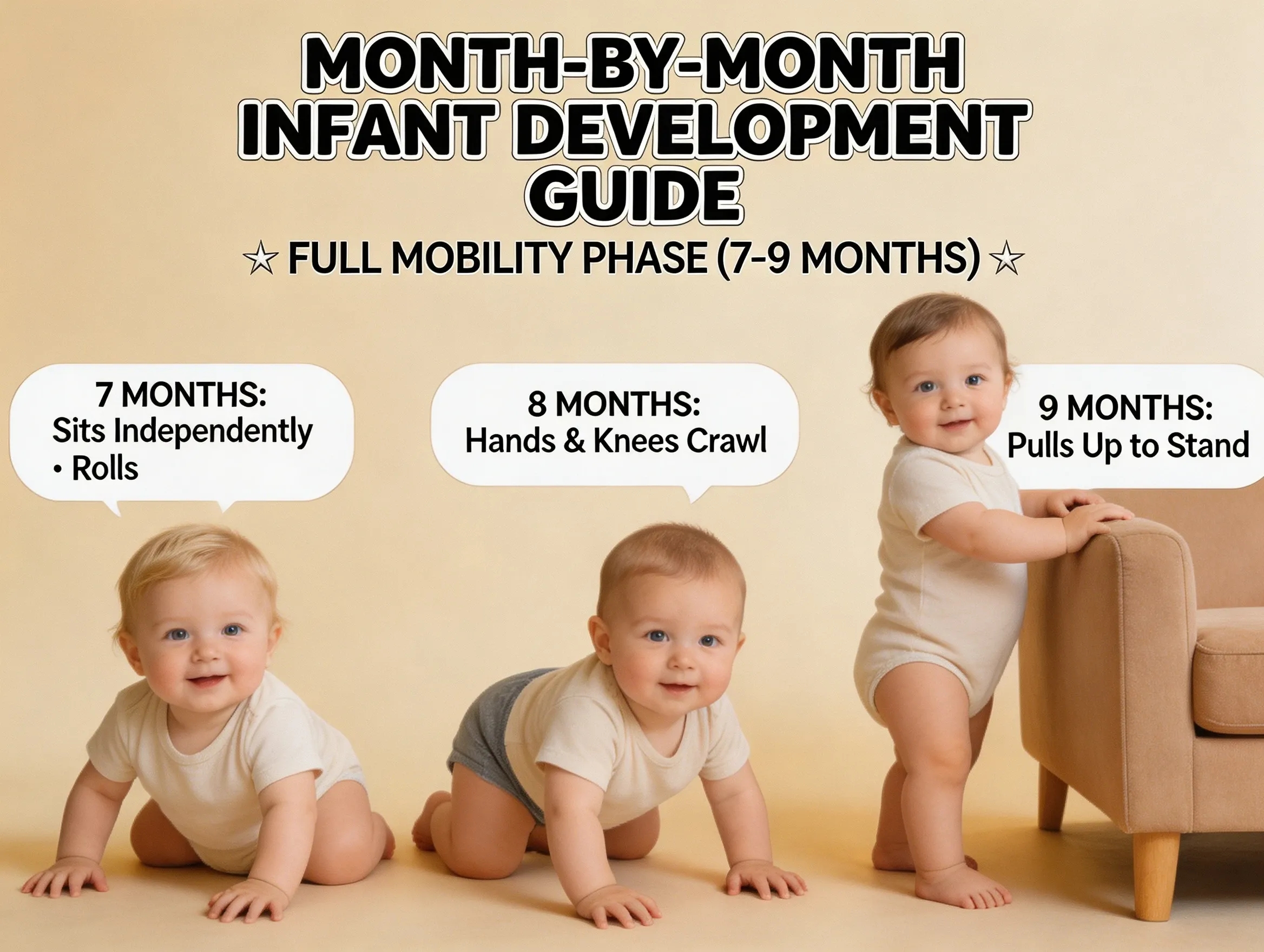
Month-by-Month Infant Development Guide: Full Mobility Phase (7-9 Months)
- Published on
- //5 mins read/––– views
The 7-9 month window is when many babies shift from "curious observer" to "active explorer." Mobility expands quickly, and with it comes a new parenting reality: more movement, more risks, and more developmental variation.
If your baby is not following another child’s exact timeline, that alone is not a problem. The key is pattern-based progress across movement, communication, and interaction.
This guide helps you track that progress month by month.
Why 7-9 months is called a full mobility phase
During this period, babies often combine stronger trunk control with intentional movement:
- sitting becomes more stable
- floor movement increases (rolling, pivoting, scooting, or crawling patterns)
- reaching and grasping become more purposeful
- attention shifts quickly between people, objects, and sounds
It is not one "correct" movement style. Different babies use different routes to mobility.
Month 7: controlled sitting and directional movement attempts
What you may notice
- longer independent sitting (or brief unsupported sits)
- rolling with intention to reach objects
- pivoting/scooting attempts on tummy
- stronger object transfer hand-to-hand
Home support that helps
- daily supervised floor time on safe, firm surface
- place desired toys slightly out of reach to motivate movement
- short communication loops: name object, wait, respond
- practice transitions (supported sit to floor play)
Parent checkpoint
At this stage, effort patterns matter as much as outcomes. Repeated attempts are a positive sign.
Month 8: exploration acceleration
What you may notice
- clearer movement strategy (army crawl, commando crawl, rocking on hands/knees, or other pattern)
- improved reach-grasp-release control
- stronger social referencing (looking back to caregiver for cues)
- more expressive vocal play and turn-taking sounds
Home support that helps
- create safe mini obstacle pathways (pillows/soft barriers with supervision)
- offer different textures and object sizes for grasp practice
- increase interactive language during movement play
- maintain predictable calm-down routines after active sessions
Parent checkpoint
Some babies crawl later, some skip traditional crawl, and some move differently first. Track functional exploration, not social media norms.
Month 9: mobility + communication integration
What you may notice
- faster movement across spaces
- pulling to stand attempts in many babies
- stronger object permanence behaviors (searching for partially hidden objects)
- richer babble patterns and social gesture cues
Home support that helps
- anchored furniture and hazard-proof exploration zones
- simple cause-and-effect toys and container play
- gesture + word pairing ("up," "bye," "more")
- responsive naming during baby-led exploration
Parent checkpoint
By 9 months, mobility differences remain normal. Focus on trajectory and whole-child function.
Mobility safety upgrades parents should make now
As movement expands, environment matters more than toys.
Priority checklist:
- secure furniture to wall where needed
- block stair access and unsafe rooms
- remove choking hazards from floor level
- protect sharp corners and unsecured cords
- review safe sleep and supervised awake-play boundaries
Exploration should feel safe enough for practice, not restrictive enough to prevent learning.
Feeding and mobility in 7-9 months
This period often includes expanding complementary feeding practice while continuing milk feeds. Motor development (sitting control, hand use) interacts with feeding readiness and self-feeding interest.
Use paced, supervised feeding opportunities and follow local pediatric guidance for textures and safety.
What parents often misunderstand in 7-9 months
Misunderstanding 1: "If my baby is not crawling exactly at X week, development is delayed"
Milestone timing varies. Pattern and progression over time are more informative.
Misunderstanding 2: "More equipment means better motor development"
Unstructured floor exploration and responsive interaction are usually higher value.
Misunderstanding 3: "Pulling to stand early means advanced in every domain"
Development is domain-specific. Strong gross motor progress does not automatically predict language or social timing.
Misunderstanding 4: "If one milestone appears, safety setup can wait"
Mobility transitions can accelerate quickly. Safety prep should happen before full speed.
When to contact your pediatric clinician
Reach out if you notice persistent concerns such as:
- limited movement progression across weeks
- marked asymmetry or unusual movement patterns that persist
- reduced social engagement or communication responsiveness over time
- feeding and growth concerns alongside developmental worries
- loss of previously demonstrated skills
One-off variability is common. Repeated pattern concerns deserve evaluation.
FAQ
Does every baby crawl in the same way?
No. Some crawl traditionally, some scoot, some use alternate strategies, and some transition quickly toward standing patterns.
Is skipping classic crawling always a problem?
Not necessarily. Discuss with your pediatric clinician if you have broader concerns about coordination, symmetry, or progression.
What is the most useful daily activity at 7-9 months?
Safe floor exploration with responsive caregiver interaction and language-rich play.
How do I reduce injury risk without limiting development?
Childproof the environment, then allow supervised movement practice within safe boundaries.
References
- CDC: Milestones by 9 months
- CDC: Milestones by 1 year
- CDC: Milestones in Action (9 months)
- AAP HealthyChildren: Movement milestones 8 to 12 months
- AAP: Early relational health milestone timeline
- NHS: Baby moves
- NHS: Baby health and development reviews
- WHO/UNICEF: Care for Child Development resources
- WHO/UNICEF: CCD participant manual
- UNICEF Parenting: How babies learn through play
- UNICEF Parenting: Baby milestones and parenting tips
- PubMed (2024): Prone skills and motor-based problem solving in first 6 months
- PubMed (2024): Early mobility and crawling practice perspectives
Final takeaway
The 7-9 month phase is about mobility expansion, communication growth, and safety adaptation at home. Prioritize trend-based progress, responsive play, and early pediatric partnership when concerns persist.