
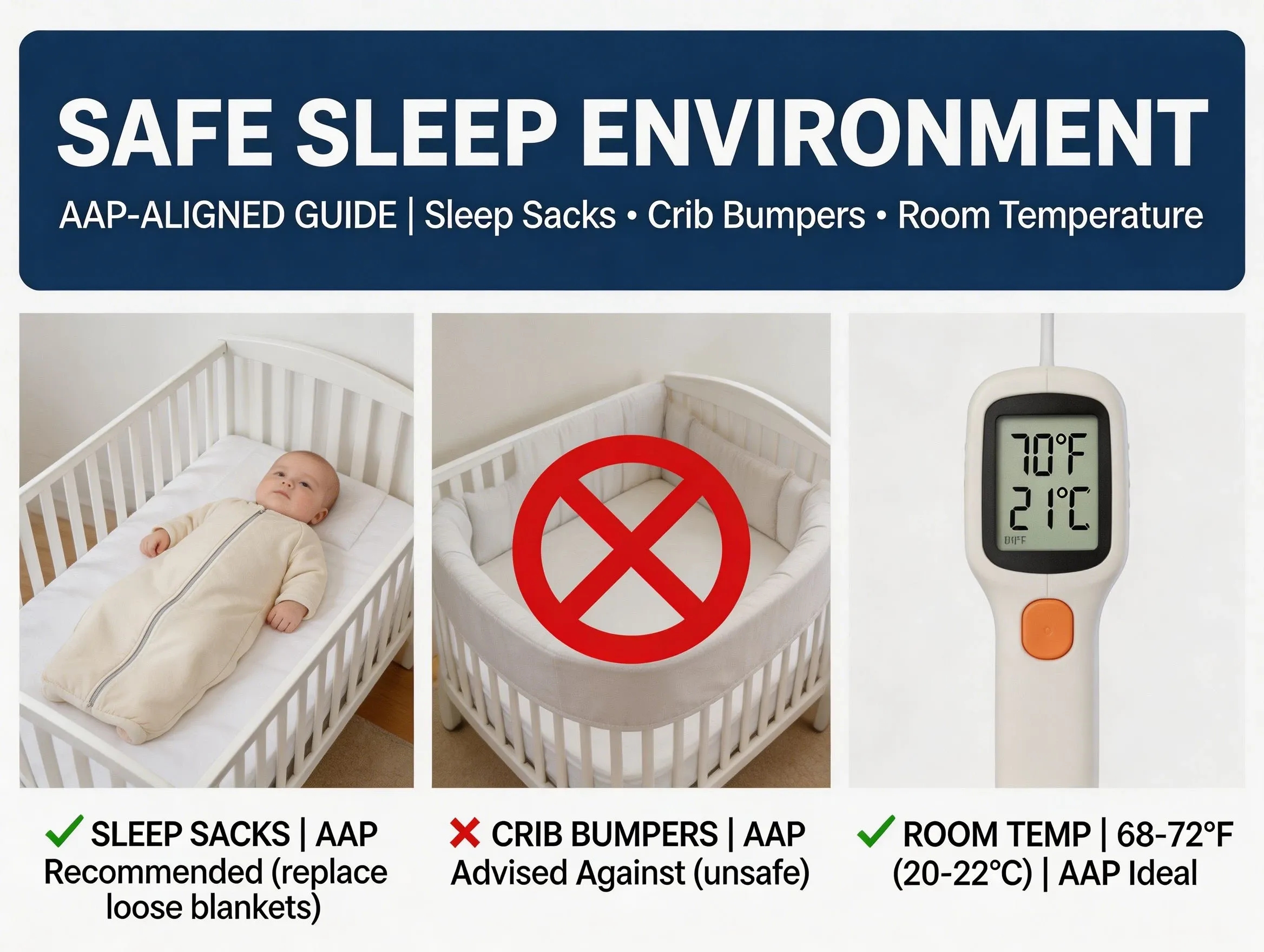
Safe Sleep Environment: AAP-Aligned Guide to Sleep Sacks, Crib Bumpers, and Room Temperature
- Published on
- //5 mins read/––– views
Creating a safe sleep environment is one of the highest-impact choices families make in the first year. Most parents are not confused about whether safety matters—they are confused by mixed advice online.
This guide translates AAP-aligned safe-sleep principles into practical daily decisions, with a focus on three high-friction topics:
- how to choose and use sleep sacks
- why crib bumpers are unsafe
- how to set room temperature without overheating
Important: this is educational guidance, not a substitute for your pediatric clinician’s advice.
Why sleep environment decisions matter
Sleep-related infant deaths are linked to modifiable environment risks, especially unsafe surfaces, soft bedding, overheating, and impaired arousal settings.
The safest approach is simple and repeatable:
- back to sleep for every sleep
- firm, flat sleep surface
- clear crib (no loose or soft items)
- avoid overheating
- keep safety rules consistent for naps and night sleep
AAP-aligned safe sleep environment checklist
Use this baseline for every sleep period:
- Place baby on their back.
- Use a safety-approved crib, bassinet, or play yard with a firm mattress and fitted sheet.
- Keep the sleep space bare: no pillows, quilts, loose blankets, bumper pads, stuffed toys, or positioners.
- Avoid weighted sleep products.
- Avoid smoke exposure and follow routine preventive care.
If caregivers alternate (parents, grandparents, childcare), consistency is essential.
Sleep sacks: how to choose safely
Sleep sacks (wearable blankets) are generally preferred over loose blankets for infants because they reduce loose-bedding risk while keeping baby warm.
What to look for
- age/size range that matches baby’s current weight and length
- snug neckline and arm openings to reduce slip-over-face risk
- free hip movement (no tight lower-body compression)
- breathable fabric appropriate to room conditions
What to avoid
- weighted sleep sacks or weighted swaddles
- oversized products with excess fabric near face
- layering that causes overheating
Practical use tips
- follow the manufacturer’s fit and thermal guidance (including TOG charts when provided)
- stop swaddling when rolling begins; transition to arms-free wearable sleep options
- for indoor sleep, avoid hats/head covering
Crib bumpers: why they are risky and not recommended
Crib bumper pads are associated with suffocation/entrapment risk and do not provide a safety benefit that outweighs those risks.
Key point for parents: "preventing limb bumps" is not a valid trade-off for potential airway compromise.
Regulatory trend also supports removal: crib bumpers are banned from sale in the U.S. under federal safe-sleep legislation implementation.
If a crib has slat spacing concerns, replace the crib with a standards-compliant product rather than adding soft barriers.
Room temperature and overheating: what to do in real life
AAP-family guidance emphasizes avoiding overheating rather than relying on one universal number for all homes.
A practical framework:
- keep room at a temperature comfortable for a lightly clothed adult
- dress baby in no more than one layer more than an adult would wear in that room
- prefer breathable sleep clothing plus correctly fitted sleep sack
- check for overheating signs rather than chasing perfect thermostat precision
Possible overheating signs include:
- sweating
- hot chest/back
- flushed skin
- damp hair
- unusual restless sleep
If these appear repeatedly, reduce layers and reassess room conditions.
Daytime naps follow the same safety rules
Naps are not an exception zone. Use the same safe sleep setup for daytime sleep:
- back sleeping position
- firm flat sleep surface
- no soft items in sleep space
- no couch/inclined sleep for routine naps
Short supervised contact naps may occur in real family life, but routine independent sleep should prioritize guideline-based safe surfaces.
Common mistakes families make
Mistake 1: "A crib bumper is safer because baby hits the rails"
Minor bumps are common and usually less dangerous than suffocation hazards from soft barriers.
Mistake 2: "If baby feels cool hands, add more layers"
Hand temperature is not a reliable overheating indicator. Check trunk/chest and behavior patterns.
Mistake 3: "Heavier sleep sacks mean better sleep"
Heavier/weighted is not safer and can increase risk.
Mistake 4: "Safe sleep rules are only for nighttime"
Risk factors apply to naps too.
When to seek pediatric guidance
Contact your pediatric clinician if you have ongoing concerns such as:
- repeated overheating signs despite environment adjustments
- persistent breathing concerns during sleep
- reflux/medical issues leading to frequent off-guideline sleep positioning attempts
- caregiver exhaustion that is affecting safe sleep consistency
Personalized planning is important when medical complexity exists.
FAQ
Are sleep sacks safer than loose blankets?
In general, yes. Properly fitted wearable blankets are preferred over loose bedding for infant sleep.
Are crib bumpers ever recommended now?
No. Current major safety guidance does not recommend bumper pads.
What is the ideal nursery temperature?
There is no universal magic number for every home. Aim for an adult-comfortable room, light layering, and no overheating signs.
Can I use the same sleep sack all year?
Usually no. Adjust fabric/TOG and layering by season and room conditions.
References
- AAP Safe Sleep hub
- AAP HealthyChildren: How to Keep Your Sleeping Baby Safe
- AAP HealthyChildren: 9 Ways to Reduce the Risk of SIDS & Suffocation
- CDC: Helping Babies Sleep Safely
- CDC: Providing Care for Babies to Sleep Safely
- NHS: Safe sleep advice for babies
- NHS: How to dress a newborn
- WHO: Safe sleep advice for newborns and children under 5
- WHO: Postnatal care recommendations
- CPSC: Safe Sleep for Babies Act implementation (crib bumper ban)
- PubMed (2024): Characteristics of sudden unexpected infant deaths on shared vs nonshared sleep surfaces
- PubMed (2024): SIDS state of the art and future directions
Final takeaway
A safe infant sleep environment is built on repeatable basics: back sleeping, a firm clear sleep surface, no bumpers, careful layering, and active overheating prevention. Keep the setup simple, consistent, and shared across all caregivers.